

From statistics to dreams: Expanding market reach with AI- powered savings planning
How can AI facilitate the savings and investment flow? How do we address the data privacy bottleneck?
Setting the Stage
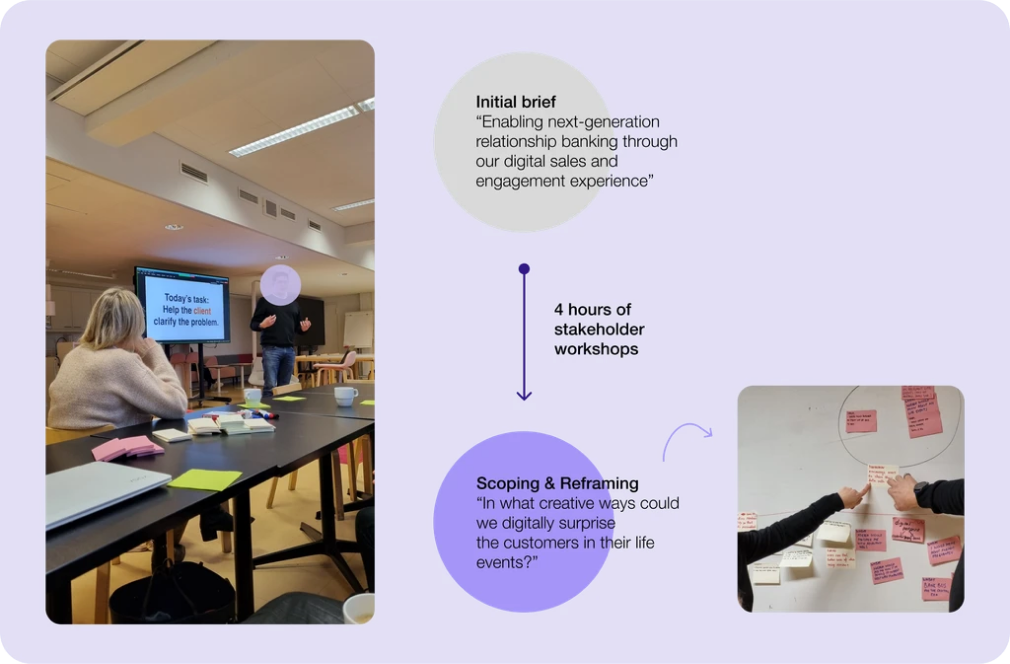
Nordea came to our team with a simple, yet challenging question: “How do we enable next-generation relationship banking through our
digital sales and engagement experience?”
This is the story of how we read between the lines, defined business-relevant goals, and delivered an AI-powered solution enabling
personalized, digital relationship banking. Our solution, “Dreamcatcher”, increased market reach by making investment and savings planning
accessible for first-time savers.
My role
UX Design & Research, Service Design, Market PositioningTimeline
UX Design & Research, Service Design, Market PositioningClient
Nordea, Universal Nordic BankIndustry
Fintech & BankingTeam
Business analyst, Marketing specialist, Graphic designer, HCI specialist, Nordea Digital CX teamShaping a viable, feasible scope
The initial brief handed to the team was abstract, without scope, and lacking clear business goals. So the first step was to narrow down the
scope, ground it based in Nordea’s current business strategy, and define goals and success metrics.
How do we define and measure success?
Does it have a "wow" element?
Is it innovative compared to existing solutions in the banking industry? Does it surprise the user with novelty?
Is it personalized?
Does it help users receive relevant, personalized services that keep them engaged? Do users feel addressed as individuals?
Can it pass data privacy concerns?
Personalized services often require users to share sensitive data, such as spending habits. Can our solution make them comfortable with agreeing to the data privacy policy?
Is it strategically scalable?
What is the market demand for the solution? Is it a one-time campaign or strategically scalable?
Users struggle to accomplish [key task] because [core problem]
Elaborate on the user pain points. What are people currently doing? Why isn't it working? What frustrations do they express? Build a compelling case for why this problem is worth solving.
60%
Of users face this issue
15min
Average time wasted
2.1
Support tickets per user
Let’s understand the context better
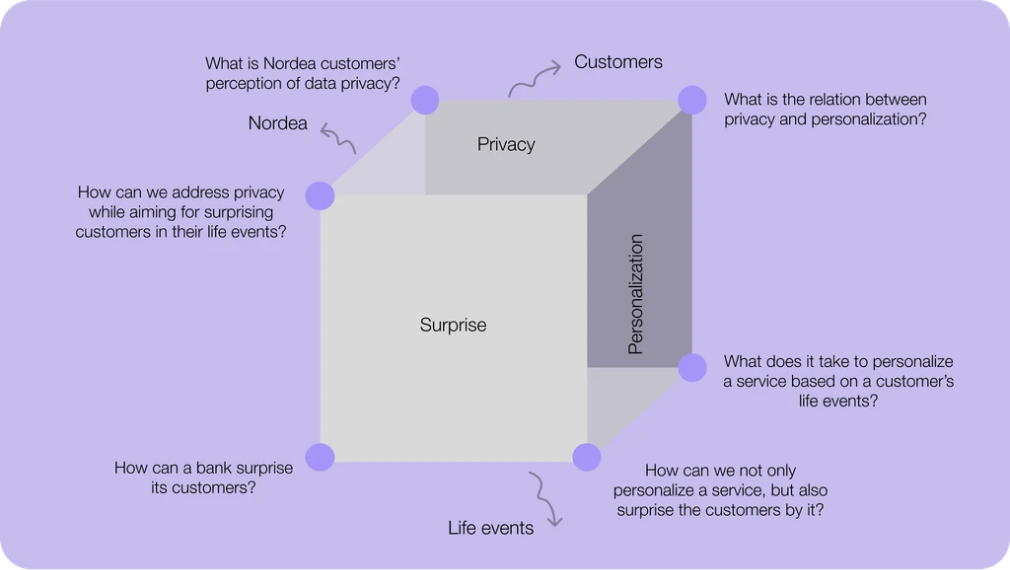
This was a multifaceted topic, with a lot of factors involved (e.g. data privacy, added value). We needed to understand how these factors impacted each other and how to priorittize them. To
further explore these aspects, we formed research questions covering the factors from various perspectives to ensure a seamless and holistic design approach.
User research
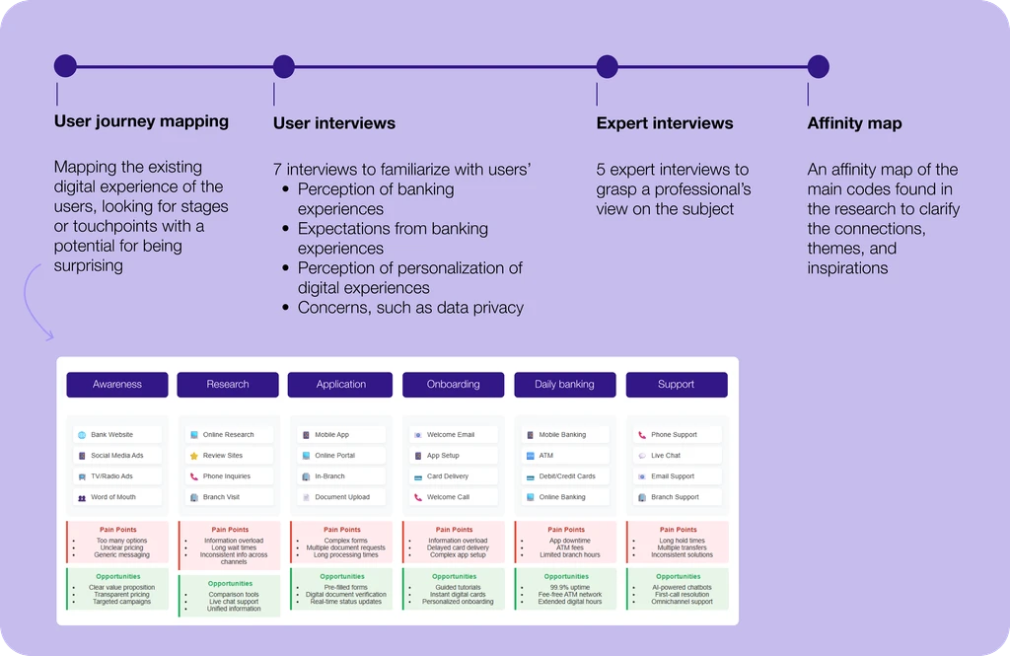
To answer the research questions, we applied three different methods. Subsequently, we synthesized data codes with an affinity map, and derived themes tobetter understand the nuances.
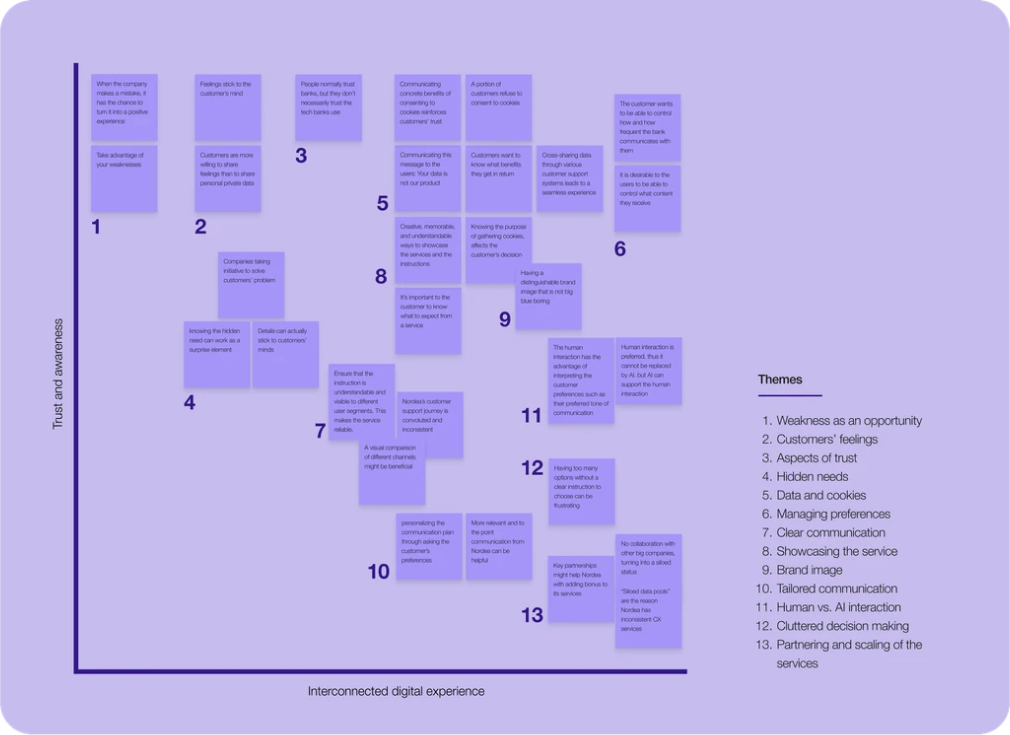
What we learned about surprising users was…surprising!
1. Defining personal surprise
Bank customers desire to be onboarded for any service they receive from a bank. So, “surprising” takes a different meaning here: The surprise element does not need to be out of the blue. It can be a “wow” moment in a standard banking services.
2. User expectations of personalization
Bank customers find the idea of a “personalized banking service” foreign, as they believe the bank only cares for their money. This implies that
with even a small touch of personalization, customers can experience a wow moment. Addressing simple yet profound hidden needs such as personalized interaction channels or easy-to-access financial consultation, can create these moments.
3. Balancing the value-effort tradeoff
The value proposition of the personalized service determines whether the customers see the service worthy of accessing their personal data or not.
4. Trusting the bank vs the technology
The trust customers place in their bank does not automatically transfer to a new technology the bank is offering. Therefore, to build trust, other actions such as transparent data usage, showcasing the technology’s added value, and adopting consent form UX patterns should be taken.
And, from a business perspective…
Potential barriers for achieving premium banking personalization were identified, with the biggest being siloed customer data pools. This led the team to think beyond customer support apps and solutions, as those would have set highly technical goals that risked derailing the project from business innovation.
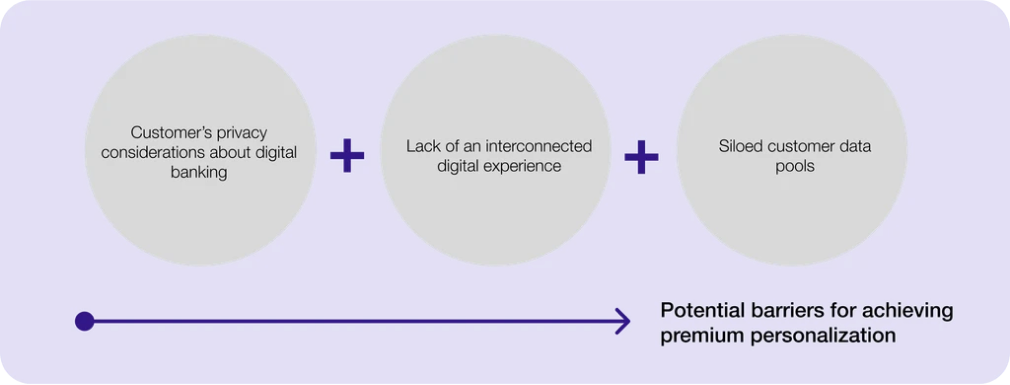
Critical moment: Constrained or empowered by data?
Throughout the research, we identified that the customers are willing to share their data in exchange for a “valuable” service. So, our mission shifted from making sure users share data to making sure the service is valuable with personalized offers.
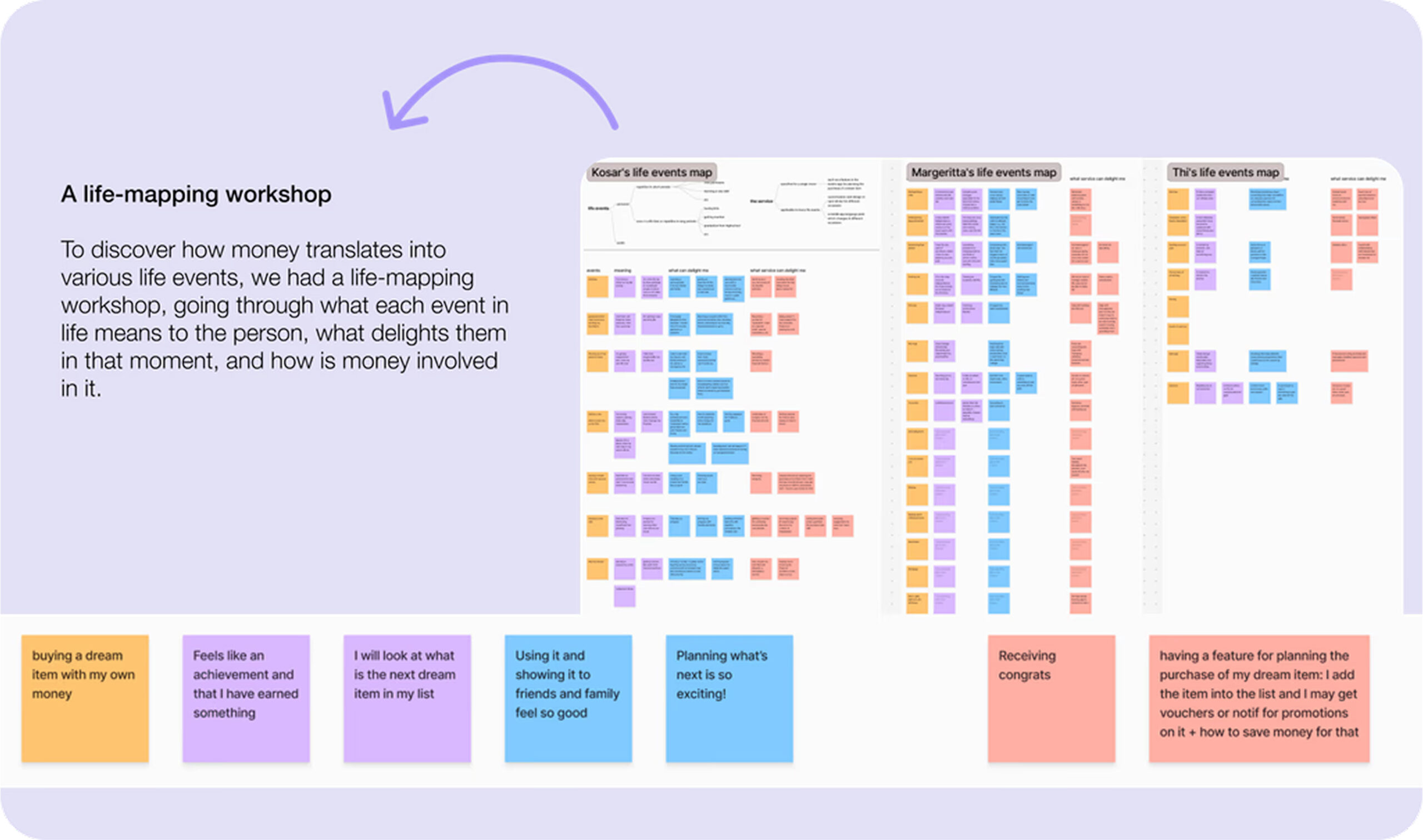
So, we asked “How does money translate into people’s lives?”
Looking back at our qualitative data, we realized that customers believe that banks merely care about their customers’ money. Not their feelings or personal life events. While money is a big source of emotion to people, for banks, it’s just numbers! How do we change this perception?
Our findings suggest that digital [banking] channels are functionally correct but emotionally devoid.
| Global Banking Consumer Study, Accenture, 2023
Now it depended on how adventurous Nordea was
Based on the research findings, the team presented Nordea multiple ideas with various effort levels to gauge how adventurous they were feeling.
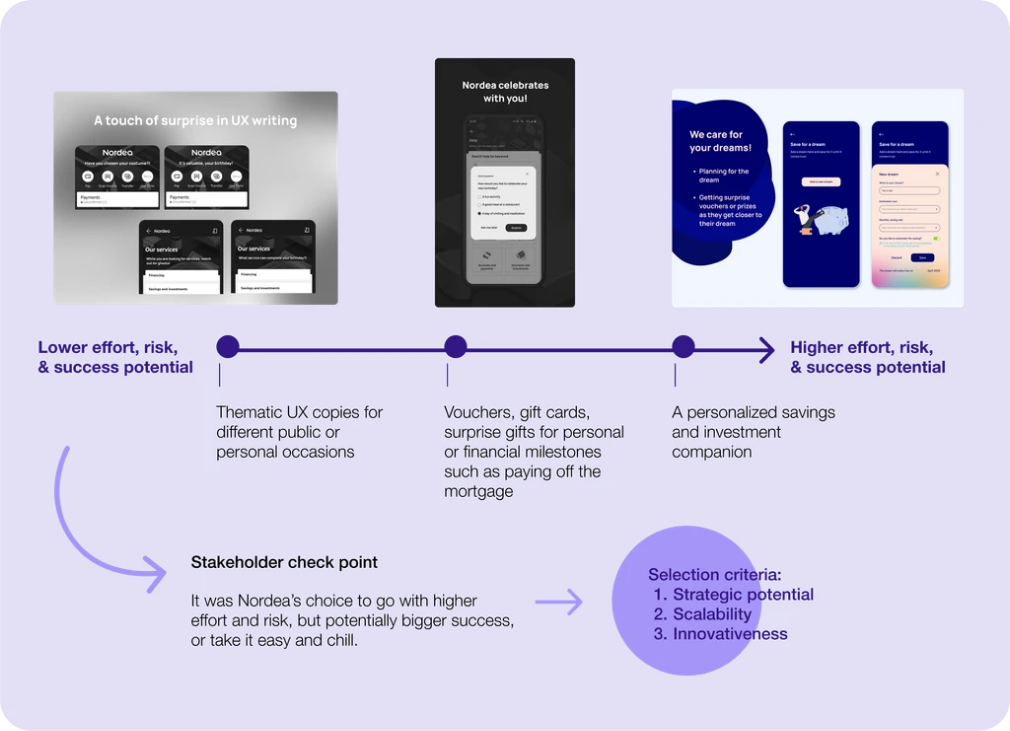
The Dreamcatcher concept of an AI-powered personalized savings companion has not only the innovativeness and surprise
element, but also a strategic potential.
| CX Manager, Nordea
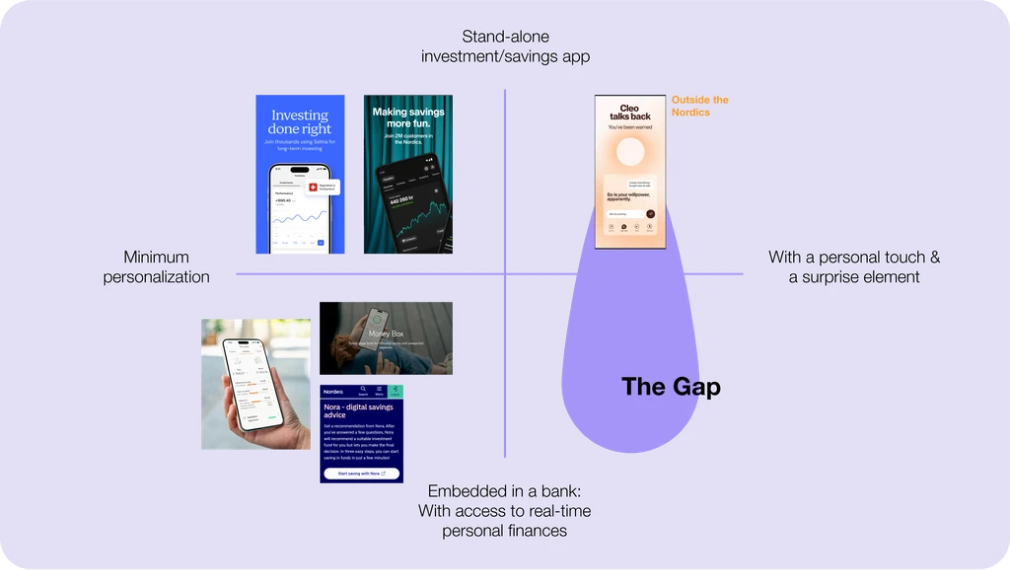
Competitor analysis & Market validation
Through competitor analysis, we validated a market for an AI-powered savings companion.

Durability & Scale
Existing platforms, usually in the form of a survey, act as a one-time guide for investment and saving.

Personalization
Existing platforms do not integrate with customer financial database, meaning low personalization.
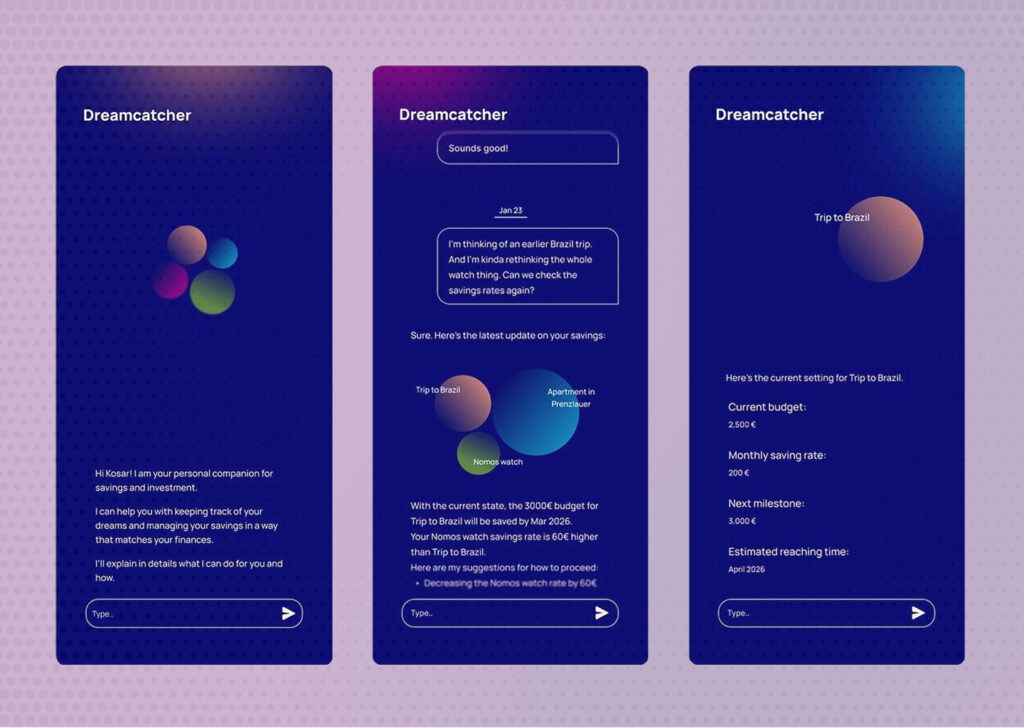
Dreamcatcher, an AI-powered savings companion
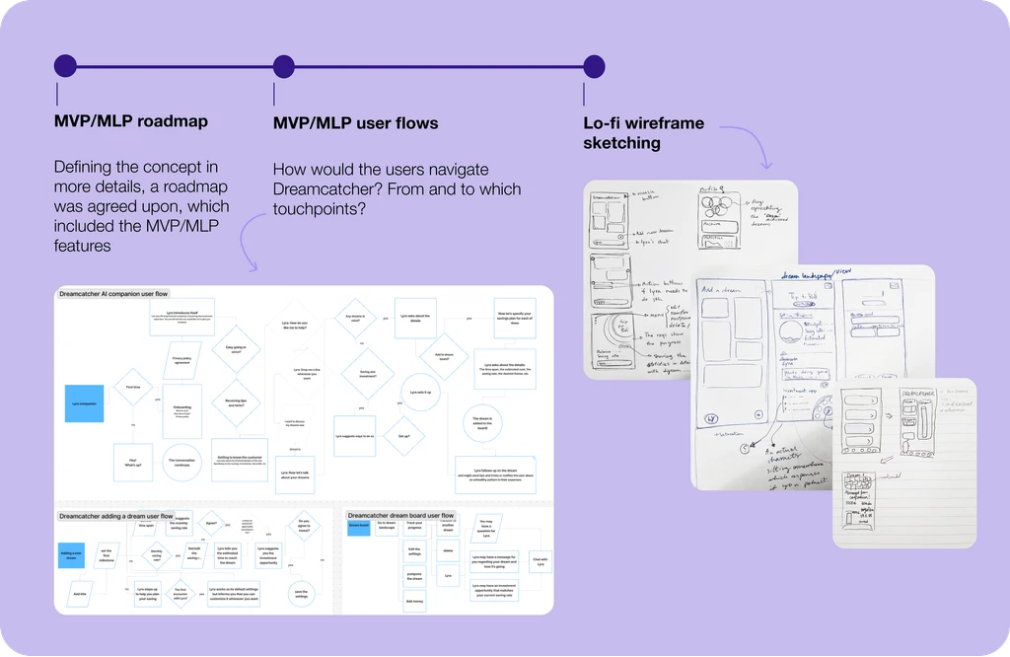
The MVP version of Dreamcatcher was defined through multiple iterations on the user flows. Lo-fi wireframe sketches were tested with multiple UI styles to find the option which blended Nordea’s visual guidelines with “dreamy-ness”.
So, what exactly is Dreamcatcher?
Dreamcatcher is a concept for an AI-powered savings assistant embedded in Nordea’s mobile banking app. The envisioned system would use a large language model with retrieval-augmented generation (RAG) to ground recommendations in the user’s actual financial data. By synthesizing spending patterns, income, and projected returns, the agent would calculate when a savings goal, a “dream”, could realistically come true.
The interaction would be conversational, with clear explanations of underlying assumptions to build trust with first-time savers.

Main target group
Young to middle-aged individuals who are new to saving and investing, with a baseline technology literacy

Key user flows
Onboarding, customizing the agent, adding a dream, goal setting, ongoing monitoring, reaching a dream, editing savings and investment plans, offboarding
Key user controls
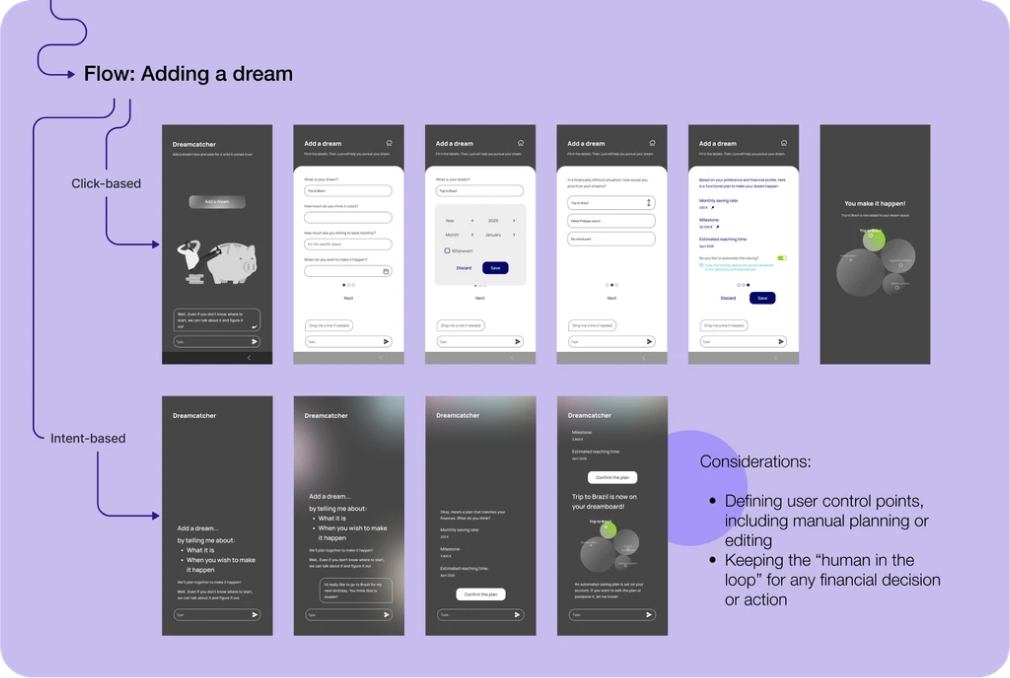
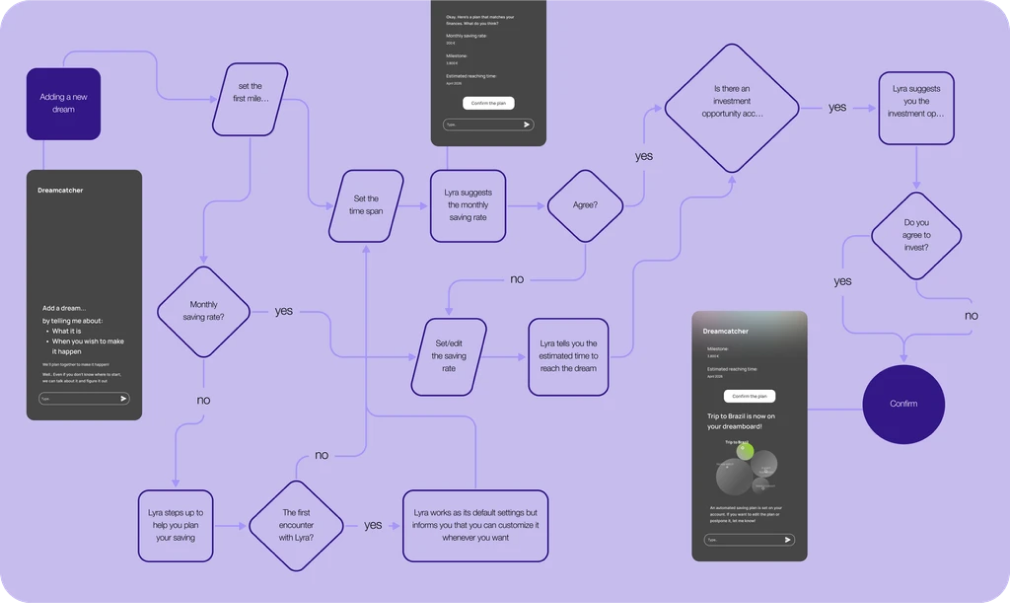
The system would never execute transactions autonomously. To keep the human in the loop, confirmation buttons for actions such as setting up a savings plan or investing in a fund were included

User data requirements
Transaction history, recurring income and pay frequency, fixed expenses, existing savings balances and interest rates, user's risk profile, and income
Translating click-based interactions to intent-based
For the 3 MVP user flows, both click-based and intent-based interactions were designed to ensure no critical functions or required control points were neglected in the overarching functions of the AI agent.
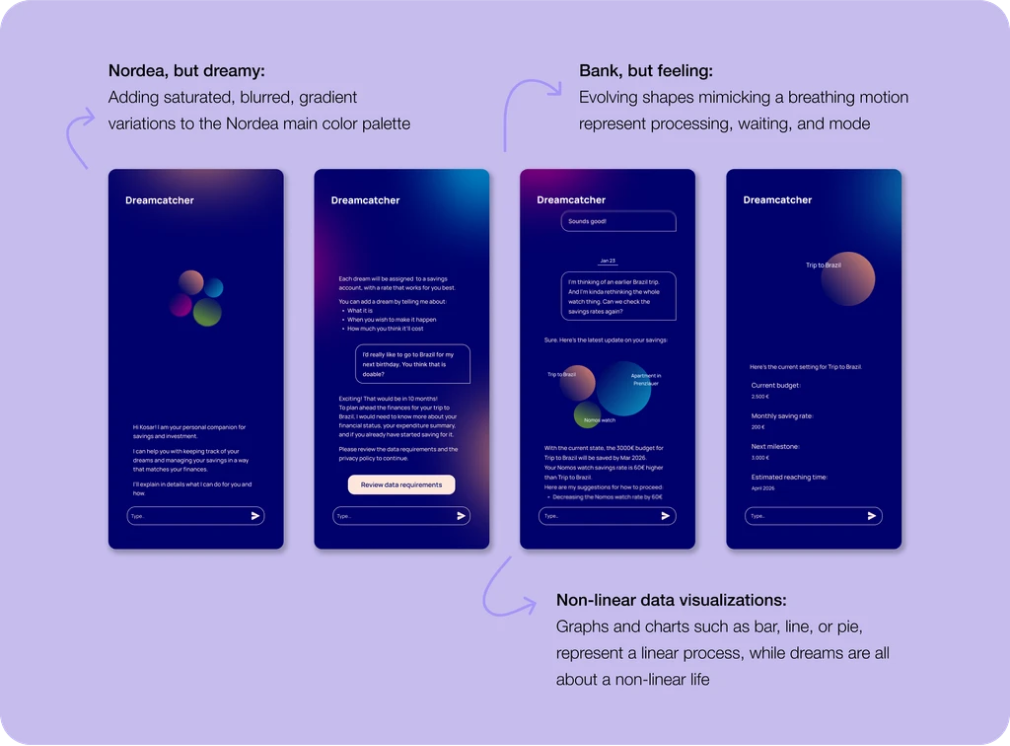
What is the look and feel of Dreamcatcher?
We defined the look and feel of Dreamcatcher based on three core elements: Matching Nordea’s brand identity, distinguishing from generic
chatbot assistants, and having a recognizable visual identity.
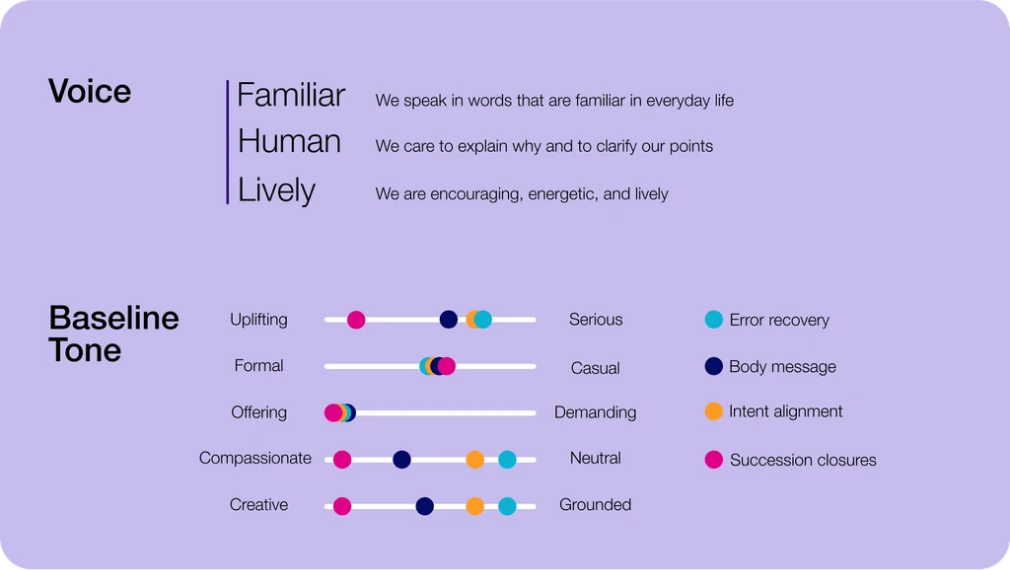
Customizable tone & voice based on users’ risk profile
Beyond Dreamcatcher’s voice and baseline tone, users can customize their companion to be more explorative and open, or risk-averse and
guiding towards more stable options.
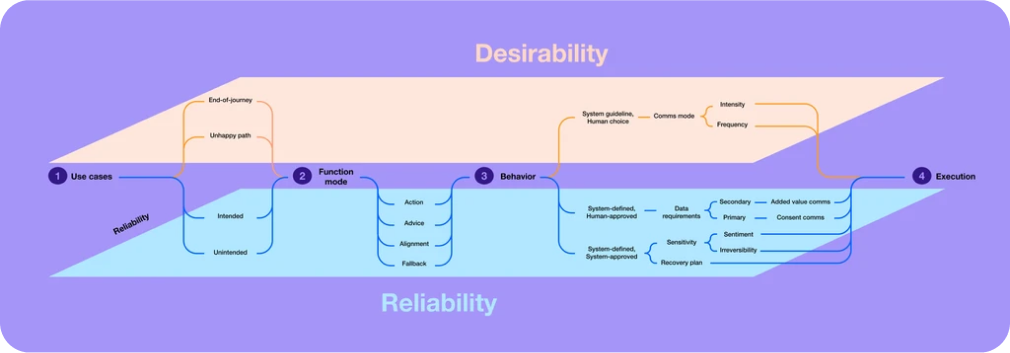
Dreamcatcher’s development plan
To develop Dreamcatcher in both desirability metrics and reliability metrics, I defined a framework to guide the client. This map demostrates
what type of use cases, function modes, and behavior models are to be explored.
Proposed value of Dreamcatcher for Nordea

Increase in market reach with a beginner- friendly savings and investment solution
Increasing customer lifetime value by offering a life-long companion for personal finances
Transitioning from the big, blue, and boring
What about for the users?

Keeping dreams alive, even under a pile of bills

Being guided through the realm of savings and investment, throughout different life stages
Finally, it was feedback time
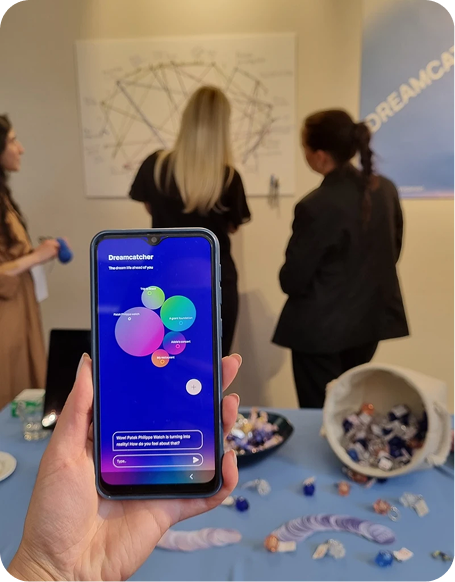
Dreamcatcher was presented to an audience of 100 people, including the Nordea stakeholders. Both the concept and product were received positively, and test users found the UI engaging and the usability straightforward. The users noted that to fully trust the AI agent, they preferred Dreamcatcher to be part of their banking app but with a separate data privacy consent form, and that their data not be used for training purposes.
Dreamcatcher brings a personal and emotional touch to savings, which is often considered a purely economical matter in banking. This is a less-explored look for banks, and is worth pursuing. Especially for a bank that doesn't want to be big, blue, and boring! | CX Manager, Nordea
12
Participants
5
Core Tasks
94%
Success Rate
Key Testing Insights
- What worked exceptionally well and why users appreciated it
- Areas that needed refinement based on user feedback
- Unexpected discoveries that led to design improvements
What comes after the MVP?
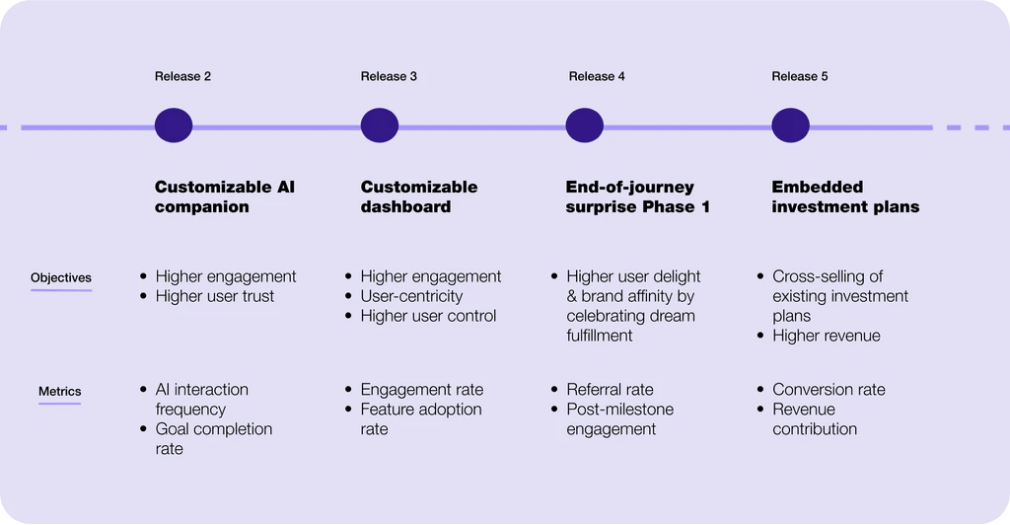
A future product roadmap was suggested to Nordea, including the implementation of user insights, such as customizability of the tone and voice of the agent.
What I learned
The meaning of highly regulated innovation
The biggest challenge in this project was to stay innovative while adhering to the tight restrictions of the banking industry. I tackled this
challenge by continuously approaching the concept of personal savings as an end-to-end process, and asking myself: But why do people
save? For many reasons, but mostly for their dreams, right?!